If you manage
A condo or rental tower
Residents, guests, couriers and trades arrive all day. Someone needs to manage the lobby, parcels and access fobs, and to respond to alarms inside the building.
On-site concierge guard
Comparison Guide
Option A
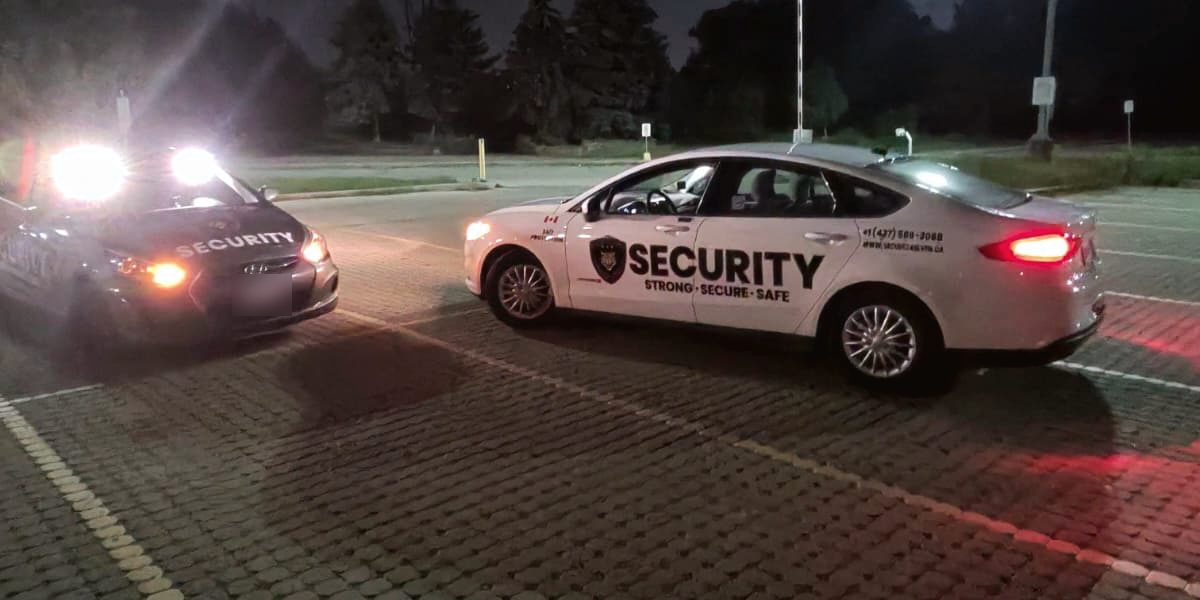
A licensed guard in a marked vehicle visits your property several times per shift, often alongside other sites on a route. Each visit is a set of checks: doors, gates, lighting, vehicles, signs of entry. Visits are logged and the guard moves on.

Option B
A licensed guard is assigned to your property for the full shift, at a desk, gate or entrance, or walking set rounds. They know your people and routines, control who comes in, and are present the moment something happens.
The short answer
Choose an on-site guard when people are on the property and someone must control access or respond instantly. Choose a mobile patrol when the property is mostly empty and the risk is after hours. Many Toronto properties are best served by a blend: a guard during busy hours and patrols overnight.
01 · The core difference
The two services are often compared on price alone, but they solve different problems. An on-site guard buys you uninterrupted attention at one place. That matters when the threat walks in during business hours: a shoplifter, a tailgater at the condo door, an unexpected contractor, a dispute at the loading dock. The guard sees it, deals with it and writes it up.
A mobile patrol buys you a trained set of eyes that returns again and again. The guard is not there between visits, so the value lies in making each visit count and in making the timing hard to predict. Research on police hot-spot patrols suggests that short, repeated and unpredictable visits can deter problems well beyond the minutes spent on site. Private patrols borrow the same logic: a thief who cannot learn the schedule cannot plan around it.
First, when do incidents actually happen? Look at past reports, alarm logs and staff complaints rather than gut feeling. Second, who is on the property at those times: staff, residents, customers, or nobody? Third, what would a missed hour cost you, in stolen stock, damage, liability or tenant trust? Fourth, what do your lease, condominium rules or insurance policy already require? The answers usually point clearly towards one service, or show exactly where a blend makes sense.
Whichever you choose, the fundamentals are the same. In Ontario, anyone working as a security guard must hold a licence under the Private Security and Investigative Services Act, and the company supplying them needs an agency licence, both of which can be checked on the province’s public registry. Supervision, written post orders and reliable reporting matter just as much on a patrol route as they do at a front desk.
Neither option is the cheap version of the other. A patrol is not a part-time guard, and a guard is not just a patrol that stands still. Pick the one that matches when and how your property is actually at risk.
02 · Decide in three questions
Start at the top and follow the answer that best describes your property on a typical week.
Landed between two answers? That is normal. We will walk the site with you, free.
03 · Side by side
A dot marks the option that usually has the edge on each point. Your site may differ.
| Factor | Mobile patrol | On-site guard |
|---|---|---|
| Presence | Periodic visits, scheduled or randomized across the shift | Continuous for every hour of the post |
| Deterrence | Marked vehicle and unpredictable timing | Constant visible presence at the entry point |
| Access control | Lock-ups, unlocks and door checks; cannot screen every entry | Screens visitors, trades and deliveries in real time |
| Response on site | Depends on where the unit is on its route | Immediate: already there |
| Large or multiple sites | One unit can cover a big footprint or several properties | One post covers one location; more ground needs more posts |
| Alarm attendance | Can be dispatched to verify alarm activations | Only where the guard is posted |
| People-facing duties | Minimal | Concierge, front desk, directions, first aid on hand |
| Proof of service | GPS-tracked visits, time-stamped photos | Shift logs, incident reports, post orders |
| Cost structure | Billed by visit or route, vehicle shared | Every hour of the post is billed |
| Main limitation | Gaps between visits | Cost of covering long, quiet hours |
04 · The blended option
Risk changes through the day, so coverage can too. A common pattern for a plaza or mixed-use building: an on-site guard through opening hours and the busy evening, then patrol visits overnight at irregular times, with the same patrol unit available to attend alarms. Builders often flip that pattern, using a guard overnight while materials are exposed and switching to mobile patrol once the building is closed in.
Alarm response is a strong reason to keep a patrol in the mix. Toronto Police Service asks monitoring stations to verify break-and-enter alarm signals before requesting police attendance, so a guard who can attend, check the building and report back closes a gap that cameras and sirens alone leave open. Our alarm response service is dispatched immediately when a signal comes in.
05 · Scenarios
Residents, guests, couriers and trades arrive all day. Someone needs to manage the lobby, parcels and access fobs, and to respond to alarms inside the building.
Trouble clusters in the evening and after closing: loitering, shoplifting, vandalism and vehicles in the lot. Daytime is busy but generally calm.
Exposed materials and equipment after hours, with long weekends the riskiest stretch. Needs change as the building closes in.
If the building is closed overnight with alarms and good fencing, patrols and alarm response fit. Round-the-clock shipping usually needs a guard at the gate.
No occupants and little to steal, but squatting, vandalism, water leaks and insurer conditions are real concerns. Regular, logged checks are the priority.
Front-desk screening during business hours, then a quiet building after close. Lock-up checks and alarm attendance cover the night.
The verdict
If people and access need managing, put a guard on site. If the property is empty and the threat comes after dark, patrol it unpredictably and attend every alarm. If both are true at different hours, blend them, and review the plan whenever the property’s use changes.
06 · Questions
It depends on the size of the site, what is exposed and its incident history. Fewer visits at unpredictable times often achieve more than many visits on a fixed timetable. We set frequency after a site assessment and adjust it as reports come in.
Ask for proof, not promises. Our patrols are GPS-tracked, and each visit is logged in a digital report with times and photos, so you can see when the guard arrived, what was checked and what was found.
Yes. Alarm response is one of the main strengths of a patrol service. A guard attends, checks the building, verifies whether there is a genuine intrusion and contacts police or emergency services when needed.
It depends on the policy. Some insurers attach conditions to vacant properties, such as an inspection by a competent person at set intervals, and some commercial policies call for someone on site at all times. Check your policy wording first, then choose the service that meets it. Written, time-stamped reports help demonstrate compliance either way. See our guide on what a guard costs in Toronto for budgeting.
Tell us about your site and the coverage you need — we’ll get back to you quickly.